The Interstate Medical Licensure Compact (IMLC) is a faster way for a physician to get a full medical license in more than one state. It doesn't create a multistate license. Each member state's own board still issues its license, and a physician needs one in every state where their patients are. So the member list shows where a physician can add states quickly, and each physician's license list decides where a practice's ads can run.
This list shows every member, with the date we last read the compact's own state map, then eligibility, fees, steps and timing as the compact states them. The Interstate Medical Licensure Compact Commission (IMLCC) runs the compact. It says imlcc.com is its only official website and that it isn't affiliated with imlcc.org. Membership changes with each legislative session, so check the sources below before you apply. This page is a summary, not legal advice.
Which states are in the IMLC in 2026?
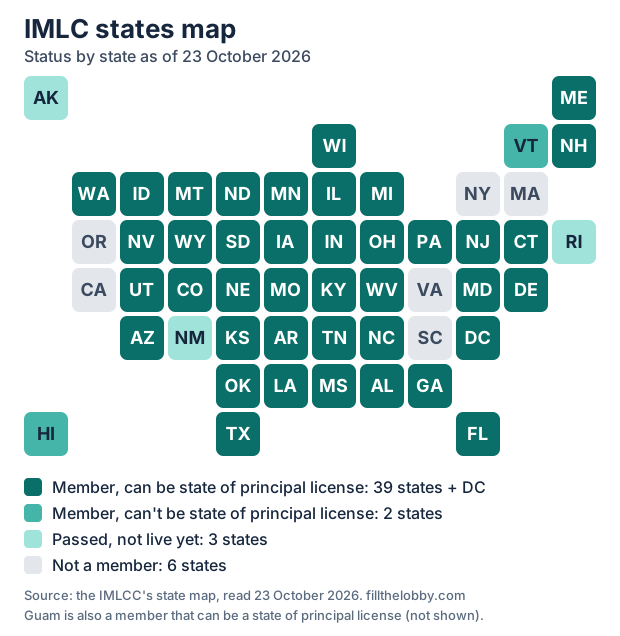
The IMLC counts 44 member states plus the District of Columbia and Guam. When we read the IMLCC's state map on 23 October 2026, 41 of those states, DC and Guam were issuing licenses through the compact. Another 3 states had passed it but weren't live yet, and 6 states were not members.
| IMLC status on 23 October 2026 | States |
|---|---|
| Member, can be a state of principal license: 39 states, DC and Guam | Alabama, Arizona, Arkansas, Colorado, Connecticut, Delaware, Florida, Georgia, Idaho, Illinois, Indiana, Iowa, Kansas, Kentucky, Louisiana, Maine, Maryland, Michigan, Minnesota, Mississippi, Missouri, Montana, Nebraska, Nevada, New Hampshire, New Jersey, North Carolina, North Dakota, Ohio, Oklahoma, Pennsylvania, South Dakota, Tennessee, Texas, Utah, Washington, West Virginia, Wisconsin and Wyoming, plus the District of Columbia and Guam |
| Member, can't be a state of principal license: 2 states | Hawaii and Vermont |
| Passed, not live yet: 3 states | Alaska, New Mexico and Rhode Island |
| Not members: 6 states | California, Massachusetts, New York, Oregon, South Carolina and Virginia |
The IMLCC's map lists the implementation in Alaska and Rhode Island as delayed and in New Mexico as in process, so physicians can't get licenses in those states through the compact yet. Alaska became part of the compact on 23 June 2026, and its release says the compact route opens once its licensing board finishes on-boarding with the IMLCC. New York has compact legislation introduced. Puerto Rico, the US Virgin Islands and the Northern Mariana Islands are not members, the IMLCC's FY2026 annual report says.
Two recent changes for members: Connecticut, where physicians from other member states could apply for licenses through the compact from October 2022, went live as a state of principal license on 15 March 2026, so physicians licensed there can now use it as their base. And from 12 October 2026, the IMLCC's homepage says, physicians can select the Arkansas State Medical Board as their state of principal license. The IMLCC refers questions about a state's participation to that state's board.
IMLC map: every state and DC
Each state's IMLC status on 23 October 2026, from the IMLCC's own map. “Member” means the state issues licenses through the compact. “Can be a state of principal license” means a physician licensed there can use it as their base to apply. “Passed, not live yet” means the IMLCC lists the state's implementation as in process or delayed. Each state name links to its page, with its licensing boards' advertising rules. Every other licensure compact, state by state, is in the table in our guide to PSYPACT and Counseling Compact states.
| State | IMLC status | Can be a state of principal license |
|---|---|---|
| Alabama | Member | Yes |
| Alaska | Passed, not live yet | Not yet |
| Arizona | Member | Yes |
| Arkansas | Member | Yes |
| California | Not a member | No |
| Colorado | Member | Yes |
| Connecticut | Member | Yes |
| Delaware | Member | Yes |
| Florida | Member | Yes |
| Georgia | Member | Yes |
| Hawaii | Member | No |
| Idaho | Member | Yes |
| Illinois | Member | Yes |
| Indiana | Member | Yes |
| Iowa | Member | Yes |
| Kansas | Member | Yes |
| Kentucky | Member | Yes |
| Louisiana | Member | Yes |
| Maine | Member | Yes |
| Maryland | Member | Yes |
| Massachusetts | Not a member | No |
| Michigan | Member | Yes |
| Minnesota | Member | Yes |
| Mississippi | Member | Yes |
| Missouri | Member | Yes |
| Montana | Member | Yes |
| Nebraska | Member | Yes |
| Nevada | Member | Yes |
| New Hampshire | Member | Yes |
| New Jersey | Member | Yes |
| New Mexico | Passed, not live yet | Not yet |
| New York | Not a member | No |
| North Carolina | Member | Yes |
| North Dakota | Member | Yes |
| Ohio | Member | Yes |
| Oklahoma | Member | Yes |
| Oregon | Not a member | No |
| Pennsylvania | Member | Yes |
| Rhode Island | Passed, not live yet | Not yet |
| South Carolina | Not a member | No |
| South Dakota | Member | Yes |
| Tennessee | Member | Yes |
| Texas | Member | Yes |
| Utah | Member | Yes |
| Vermont | Member | No |
| Virginia | Not a member | No |
| Washington | Member | Yes |
| Washington, DC | Member | Yes |
| West Virginia | Member | Yes |
| Wisconsin | Member | Yes |
| Wyoming | Member | Yes |
Guam is a member too, and can serve as a state of principal license.
What is the Interstate Medical Licensure Compact?
The IMLC is an agreement among US states and territories, each of which joins by passing a law. The IMLCC calls it “a voluntary, expedited pathway to licensure for physicians who qualify.” A physician completes one application and receives a separate license from each state they choose. Those licenses are “still issued by the individual states”, and the Commission “does not issue a ‘Compact license’ or a nationally recognized medical license,” as its page on how the compact works puts it.
The compact became operational in April 2017. The Commission administers it for the member states, and each state sends two commissioners from its medical or osteopathic board. Member boards share complaint and investigative information. If one board acts against a physician licensed through the compact, the others are notified and can take similar action through their own process, the IMLCC's FAQs say.
That makes it different from PSYPACT and the Counseling Compact, which give psychologists and counselors a privilege to practice in other member states instead of another license. Under the IMLC, a physician still holds a full license in each state.
Which IMLC states can be your state of principal license?
A physician's state of principal license (SPL) is the member state where they hold a full, unrestricted license and which they name as their base in the compact. The IMLCC says it is also sometimes called a home state. 39 states, DC and Guam can serve as one. Hawaii and Vermont issue licenses through the compact but can't be a physician's SPL, and the states that have passed the compact but aren't live can't be one yet.
To name a state as their SPL, a physician must meet at least one of these:
- Their primary residence is in that state.
- At least 25% of their practice of medicine is there.
- They are employed to practice medicine by a person, business or organization located there.
- They use it as their state of residence for US federal income tax.
The SPL decides whether a physician meets these. Physicians must keep their SPL status at all times. After they receive a Letter of Qualification, they can move it to another member state, which the IMLCC calls redesignation.
Who is eligible for an IMLC license?
Besides a full, unrestricted license in a member state that can serve as their SPL, the IMLCC says a physician must:
- Have graduated from an accredited medical school, or one listed in the International Medical Education Directory or an equivalent such as the World Directory of Medical Schools.
- Have completed ACGME- or AOA-accredited graduate medical education. Training outside the US counts only if the program held that accreditation while the physician attended; the IMLCC says this most often affects physicians trained in Canada.
- Have passed each component of the USMLE, COMLEX-USA or an equivalent in no more than three attempts per component. The Canadian LMCC doesn't meet this requirement.
- Hold a current specialty certification, or a time-unlimited one, from an ABMS or AOABOS board.
- Have no history of disciplinary or controlled substance action against their medical license, no criminal history, and no current investigation.
The IMLCC estimates that about 80% of US physicians meet these criteria. Each physician decides for themselves whether they qualify before applying, and the application fee isn't refunded if they turn out not to. In the IMLCC's Year 9 data study, 7% of completed applications ended with a finding that the physician wasn't eligible.
Both MDs and DOs can use the compact. Member states' osteopathic boards take part, and the rules accept COMLEX-USA, AOA-accredited training and AOABOS certification. The IMLCC says the compact treats all physicians equally, without preference for specialty.
How much does an IMLC license cost?
Applying through the IMLC costs $700, plus the license fee of each state you choose. All fees are non-refundable, according to the IMLCC's cost page. While a Letter of Qualification is valid, adding another state costs $100 plus that state's fee, its FAQs say. Since August 2026, credit card payments carry a processing fee of 2.9% plus 30 cents per transaction, and paying by ACH avoids it. Renewal fees are set by each state's board.
The initial state fees on the IMLCC's list run from $35 (Pennsylvania, M.D.) to $895 (Texas). A physician who applies and asks for M.D. licenses in Texas and Florida, for example, pays $700 + $895 + $355 = $1,950, before any credit card fee.
| Member | Licensing board | Initial license fee through the IMLC |
|---|---|---|
| Alabama | Alabama Medical Licensure Commission | $75 |
| Arizona (M.D.) | Arizona Medical Board | $500 |
| Arizona (D.O.) | Arizona Board of Osteopathic Examiners | $400 |
| Arkansas | Arkansas State Medical Board | $120 |
| Colorado | Colorado Medical Board | $362 |
| Connecticut | Connecticut Department of Public Health | $565 |
| Delaware | Delaware Board of Medical Licensure and Discipline | $430 |
| District of Columbia | DC Board of Medicine | $805 |
| Florida (M.D.) | Florida Board of Medicine | $355 |
| Florida (D.O.) | Florida Board of Osteopathic Medicine | $305 |
| Georgia | Georgia Composite Medical Board | $500 |
| Guam | Guam Board of Medical Examiners | $400 |
| Hawaii (M.D.) | Hawaii Medical Board | $392 |
| Hawaii (D.O.) | Hawaii Medical Board | $384 |
| Idaho | Idaho Board of Medicine | $320 |
| Illinois | Illinois Division of Professional Regulation | $500 |
| Indiana | Indiana Medical Licensing Board | $250 |
| Iowa | Iowa Board of Medicine | $450 |
| Kansas | Kansas Board of Healing Arts | $300 |
| Kentucky | Kentucky Board of Medical Licensure | $300 |
| Louisiana | Louisiana Medical Board | $382 |
| Maine (M.D.) | Maine Board of Licensure in Medicine | $700 |
| Maine (D.O.) | Maine Board of Osteopathic Medicine | $350 |
| Maryland | Maryland Board of Physicians | $790 |
| Michigan (M.D.) | Michigan Board of Medicine | $375 |
| Michigan (D.O.) | Michigan Board of Osteopathic Medicine and Surgery | $375 |
| Minnesota | Minnesota Board of Medical Practice | $392 |
| Mississippi | Mississippi State Board of Medical Licensure | $600 |
| Missouri | Missouri Board of Healing Arts | $102 |
| Montana | Montana Board of Medical Examiners | $375 |
| Nebraska | Nebraska Board of Medicine and Surgery | $350 |
| Nevada (M.D.) | Nevada State Board of Medical Examiners | $800 |
| Nevada (D.O.) | Nevada State Board of Osteopathic Medicine | $500 |
| New Hampshire | New Hampshire Board of Medicine | $413 |
| New Jersey | New Jersey State Board of Medical Examiners | $805 |
| North Carolina | North Carolina Medical Board | $550 |
| North Dakota | North Dakota Board of Medicine | $400 |
| Ohio | Ohio Medical Board | $308.50 |
| Oklahoma (M.D.) | Oklahoma State Board of Medical Licensure & Supervision | $500 |
| Oklahoma (D.O.) | Oklahoma State Board of Osteopathic Examiners | $625 |
| Pennsylvania (M.D.) | Pennsylvania State Board of Medicine | $35 |
| Pennsylvania (D.O.) | Pennsylvania State Board of Osteopathic Medicine | $205 |
| South Dakota | South Dakota Board of Medical and Osteopathic Examiners | $400 |
| Tennessee (M.D.) | Tennessee Board of Medical Examiners | $510 |
| Tennessee (D.O.) | Tennessee Board of Osteopathic Examination | $310 |
| Texas | Texas Medical Board | $895 |
| Utah (M.D.) | Utah Physicians & Surgeons Licensing Board | $200 |
| Utah (D.O.) | Utah Osteopathic Physicians & Surgeons | $200 |
| Vermont (M.D.) | Vermont Board of Medical Practice | $650 |
| Vermont (D.O.) | Vermont Board of Osteopathic Physicians | $450 |
| Washington (M.D.) | Washington Medical Commission | $511 |
| Washington (D.O.) | Washington Board of Osteopathic Medicine and Surgery | $411 |
| West Virginia (M.D.) | West Virginia Board of Medicine | $400 |
| West Virginia (D.O.) | West Virginia Board of Osteopathic Medicine | $400 |
| Wisconsin | Wisconsin Medical Examining Board | $120 |
| Wyoming | Wyoming Board of Medicine | $325 |
Fees as listed on the IMLCC's cost page on 23 October 2026. They change, so check the cost page and each board before you apply.
How to get a license through the IMLC
- Check your eligibility first. The IMLCC asks each physician to confirm they qualify, and that they understand the compact's rules, before applying, because the fee isn't refunded if they don't qualify.
- Apply on imlcc.com. Give your demographic and professional details, choose your SPL from the member states where you already hold a full license, and pay the $700 fee. Then submit fingerprints to the designated criminal justice agency in your SPL for a criminal background check.
- Get your Letter of Qualification. Your SPL verifies your qualifications from primary sources, runs the background check, and issues a Letter of Qualification (LOQ) if you meet every requirement. The LOQ is valid for 365 days, with no waivers.
- Choose your states. Each state you select issues a license once it receives your LOQ, and may then ask for extra information its own medical practice act requires. You can add states while the LOQ is valid. After it expires, you reapply and pay a new application fee.
- Renew through the compact. Each state must notify you 90 days before a license issued through the compact expires, and you renew those licenses on the compact's website.
How long does the IMLC take?
The IMLCC's Year 9 data study covers 10,837 applications completed between 1 April 2025 and 31 March 2026. On average, 38 days passed from the application being received to the LOQ being issued, with 55% done within 30 days. From the date a physician was found qualified to the date the requested licenses were issued took 22 days on average, with 47% within 7 days. Applicants obtained 4 licenses on average. These are the IMLCC's averages across all applications, not a timeline for any single one.
What the IMLC means for telehealth marketing
Under the compact, the IMLCC's FAQs say, medicine is practiced in the state where the patient is located, and that state's laws apply. So a telehealth physician needs a license in each patient's state, and ads should reach only those states. The IMLC makes adding a state faster, but it doesn't widen where a physician can practice until the new license is issued.
- Target ads by license list, not by the map. Fill The Lobby sets ad locations to the states on each physician's license list, not to the IMLC map. In Google Ads, that means the “Presence” option, which reaches people in or regularly in those states, rather than the default, “Presence or interest”, which also reaches people who have only shown interest in them (see Google's advanced location options).
- Add a state when its license is issued. An LOQ isn't a license. Add a new state to the ad locations and the booking page once its board issues the license, and not before.
- Map each physician in a group. One physician may hold licenses in eight states and another in two. Booking should offer each physician's openings only to patients located in that physician's states.
- Ask where the patient will be. Asking at booking where the patient will be during the visit is a location question, not a health question, and it flags a patient who will be in a state where the physician has no license.
This matters most for physician-led telehealth: psychiatry practices offering telepsychiatry, concierge and direct primary care practices that see members by video, and GLP-1 weight loss programs that run visits online. Psychologists, counselors and social workers have their own compacts, covered in our guide to PSYPACT and Counseling Compact states.
Fill The Lobby is a patient acquisition and retention agency for cash-pay and private-pay practices of every size, from a solo clinician to a large group practice. Fill The Lobby starts with an audit and a roadmap before anything is built, reports every booking with its source and cost, and keeps every account in the practice's name. The 30-day Proof Pilot is a flat $2,500, and after the pilot, plans are priced per practice by clinician count.
Sources
- IMLCC — Participating states (compact map) and IMLCC — Home page (map legend, snapshot stats and news), checked 23 October 2026
- IMLCC — A faster pathway to physician licensure, checked 23 October 2026
- IMLCC — What does it cost?, checked 23 October 2026
- IMLCC — FAQs, checked 23 October 2026
- IMLCC — Press releases and publications, checked 23 October 2026
- IMLCC — FY2026 Annual Report (PDF), checked 23 October 2026
- IMLCC — Data Study Year 9, 10 June 2026 (PDF), checked 23 October 2026
- IMLCC — Alaska finalizes legislation, welcomed as the 44th state member, 26 June 2026 (PDF), checked 23 October 2026
- IMLCC — Connecticut going live as a state of principal licensure, 15 March 2026 (PDF), checked 23 October 2026
- IMLCC — Notice of new credit card payment processing policy, 15 June 2026 (PDF), checked 23 October 2026
- Google Ads Help — About advanced location options, checked 23 October 2026